Short answer · Medically reviewed summary · Last updated: 2026-05-08

Autosomal recessive multiple pterygium syndrome, also known as Escobar syndrome, is a hereditary genetic condition caused by mutations in the CHRNG gene. It follows an autosomal recessive inheritance pattern, meaning an individual must inherit two copies of the mutated gene—one from each carrier parent—to manifest the syndrome. Is Escobar syndrome hereditary? Yes, Autosomal recessive multiple pterygium syndrome (Escobar syndrome) is strictly hereditary.

11

Is Autosomal recessive multiple pterygium syndrome / Escobar syndrome hereditary?

Is Autosomal recessive multiple pterygium syndrome / Escobar syndrome hereditary? The genetic component explained in plain language, reviewed against medical sources, with patient experiences.
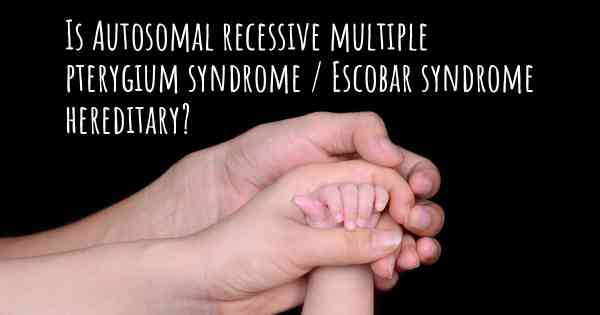
Is Autosomal recessive multiple pterygium syndrome / Escobar syndrome hereditary?

Autosomal recessive multiple pterygium syndrome, also known as Escobar syndrome, is a hereditary genetic condition caused by mutations in the CHRNG gene. It follows an autosomal recessive inheritance pattern, meaning an individual must inherit two copies of the mutated gene—one from each carrier parent—to manifest the syndrome.


Is Escobar syndrome hereditary?


Yes, Autosomal recessive multiple pterygium syndrome (Escobar syndrome) is strictly hereditary. It is classified as an autosomal recessive disorder, which means the condition is passed down through families via specific genetic mutations. It is not caused by environmental factors, and because it is recessive, parents who are asymptomatic carriers of a CHRNG mutation have a 25% chance with each pregnancy of having a child affected by Escobar syndrome.


How is the condition passed through families?


In Autosomal recessive multiple pterygium syndrome, both biological parents must be carriers. When both parents carry one copy of the mutated gene, the following outcomes are statistically possible for each pregnancy:


  • 25% chance the child will inherit two mutated genes and have Escobar syndrome.

  • 50% chance the child will be an asymptomatic carrier like the parents.

  • 25% chance the child will inherit no mutated genes.


Is genetic testing available for Escobar syndrome?


Molecular genetic testing is available to confirm a diagnosis of Autosomal recessive multiple pterygium syndrome. Testing typically involves sequencing the CHRNG gene to identify pathogenic variants. Genetic counseling is strongly recommended for families affected by Escobar syndrome to understand recurrence risks and explore reproductive options, such as preimplantation genetic testing (PGT) or prenatal diagnosis via chorionic villus sampling (CVS) or amniocentesis.


Are de novo mutations common in this syndrome?


De novo (spontaneous) mutations are not the typical cause of Autosomal recessive multiple pterygium syndrome. Because the condition is autosomal recessive, it is almost exclusively inherited from carrier parents. While extremely rare occurrences exist in genetics, the clinical presentation of this syndrome is consistently linked to the inheritance of two recessive alleles.


Next steps


  • Consult a board-certified clinical geneticist to discuss CHRNG gene testing.

  • Connect with the 2 community members on DiseaseMaps.org who have shared their experiences with Autosomal recessive multiple pterygium syndrome.

  • Request a referral to a genetic counselor to review family history and reproductive risks.


Medical disclaimer: This information is for educational purposes only and should not replace professional medical advice, diagnosis, or treatment.


References


  • NIH Genetic and Rare Diseases Information Center (GARD): Multiple Pterygium Syndrome, Escobar Type.

  • Orphanet: Escobar syndrome (ORPHA:772).

  • Online Mendelian Inheritance in Man (OMIM): Multiple Pterygium Syndrome, Escobar Type (#265000).

Author: DiseaseMaps Editorial Team
Reviewed against authoritative medical sources (NIH GARD, Orphanet, OMIM)
Last updated: 2026-05-08
Medical disclaimer: This information does not substitute professional medical advice. Always consult your doctor before making health decisions.
Source: DiseaseMaps.org
1 answer

Is Autosomal recessive multiple pterygium syndrome / Escobar syndrome hereditary?

Autosomal recessive multiple pterygium syndrome / Escobar syndrome life expectancy

What is the life expectancy of someone with Autosomal recessive multiple pt...

1 answer
Celebrities with Autosomal recessive multiple pterygium syndrome / Escobar syndrome

Celebrities with Autosomal recessive multiple pterygium syndrome / Escobar ...

1 answer
Is Autosomal recessive multiple pterygium syndrome / Escobar syndrome contagious?

Is Autosomal recessive multiple pterygium syndrome / Escobar syndrome conta...

2 answers
ICD9 and ICD10 codes of Autosomal recessive multiple pterygium syndrome / Escobar syndrome

ICD10 code of Autosomal recessive multiple pterygium syndrome / Escobar syn...

1 answer
Natural treatment of Autosomal recessive multiple pterygium syndrome / Escobar syndrome

Is there any natural treatment for Autosomal recessive multiple pterygium s...

1 answer
Living with Autosomal recessive multiple pterygium syndrome / Escobar syndrome

Living with Autosomal recessive multiple pterygium syndrome / Escobar syndr...

1 answer
Autosomal recessive multiple pterygium syndrome / Escobar syndrome diet

Autosomal recessive multiple pterygium syndrome / Escobar syndrome diet. Is...

1 answer
History of Autosomal recessive multiple pterygium syndrome / Escobar syndrome

What is the history of Autosomal recessive multiple pterygium syndrome / Es...

1 answer

World map of Autosomal recessive multiple pterygium syndrome / Escobar syndrome

Find people with Autosomal recessive multiple pterygium syndrome / Escobar syndrome through the map. Connect with them and share experiences. Join the Autosomal recessive multiple pterygium syndrome / Escobar syndrome community.

Stories of Autosomal recessive multiple pterygium syndrome / Escobar syndrome

AUTOSOMAL RECESSIVE MULTIPLE PTERYGIUM SYNDROME / ESCOBAR SYNDROME STORIES

Tell your story and help others

Tell my story

Autosomal recessive multiple pterygium syndrome / Escobar syndrome forum

AUTOSOMAL RECESSIVE MULTIPLE PTERYGIUM SYNDROME / ESCOBAR SYNDROME FORUM

Ask a question and get answers from other users.

Ask a question

Find your symptoms soulmates

From now on you can add your symptoms in diseasemaps and find your symptoms soulmates. Symptoms soulmates are people with similar symptoms to you.

Symptoms soulmates

Add your symptoms and discover your soulmates map

Soulmates map